
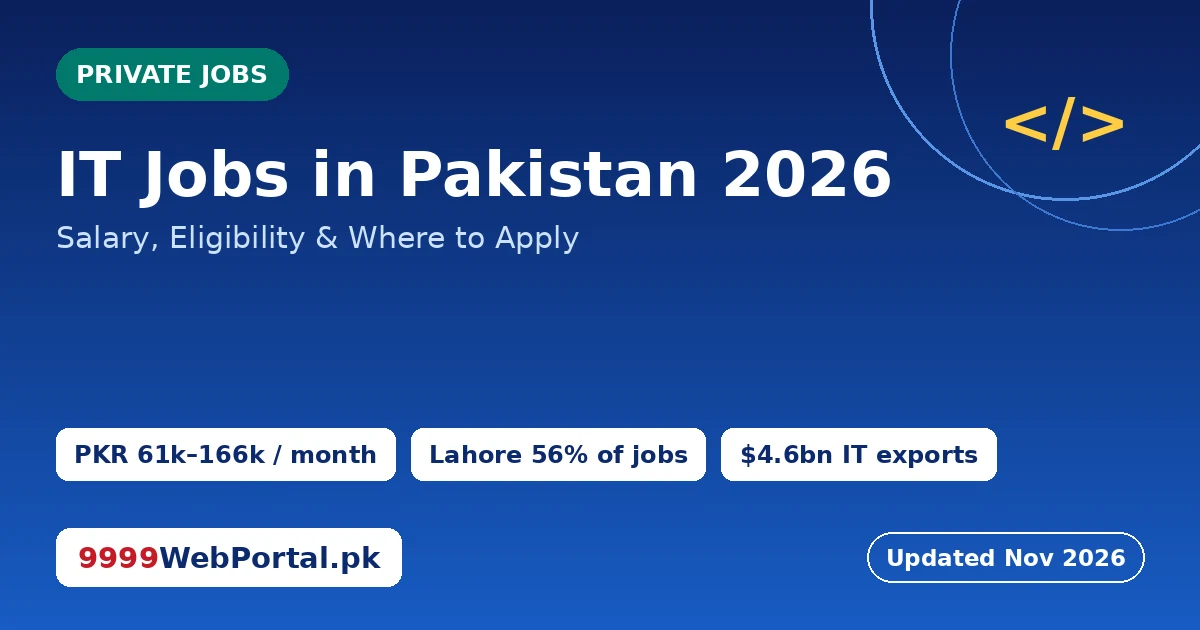
Quick answer: IT jobs in Pakistan are the country’s fastest-growing career path in 2026: IT and IT-enabled services exports hit a record of about $4.6 billion in FY2025-26, and more than 2.37 million Pakistanis are registered as freelancers with the Pakistan Software Export Board. A typical software engineer earns about PKR 61,000–166,000 a month (Glassdoor, October 2026), juniors start around PKR 40,000–115,000, and senior engineers earn a median of about PKR 146,000 — with remote work for foreign clients paying far more. Lahore is the biggest IT job market with 56% of advertised IT jobs, followed by Karachi and Islamabad. You can enter with a CS degree, a bootcamp, or a self-taught portfolio — employers hire proof of skill, not just paper. No genuine employer charges a fee for an IT job or an offer letter.
| IT jobs in Pakistan: at a glance | |
|---|---|
| Market size | IT & ITeS exports about $4.6 billion in FY2025-26 (record); freelancers earned $1.76 billion in total freelance exports, $1.16 billion of it from IT |
| Biggest job market | Lahore — 56% of advertised IT jobs in 2026; Karachi and Islamabad share most of the rest |
| Typical pay | Software engineer PKR 61,000–166,000 a month; junior PKR 40,000–115,000; senior median about PKR 146,000 |
| Most advertised roles | Software engineer, full stack developer, graphic designer, business development, social media marketing, QA, DevOps, data & AI |
| How to enter | CS/SE degree, or a bootcamp plus a GitHub portfolio with 2–3 real projects; internships are the usual first step |
| Freelance option | Upwork and Fiverr; PSEB registration gives a 0.25% final tax rate on IT export income and formal freelancer status |
Last updated: 27 November 2026. Salary figures below come from Glassdoor (October 2026, 7,700+ reported salaries), Indeed job adverts (November 2026), ITJobsInPakistan’s analysis of 1,817 IT jobs posted in 2026, and State Bank of Pakistan export data reported in July–November 2026. Pay varies sharply by employer type — local agency, export company or direct remote work — so read the ranges with the market in mind.
Pakistan’s IT sector is no longer a niche — it is the country’s most credible export story. In FY2025-26 the sector earned about $4.6 billion, a record, and freelancers alone brought in $1.76 billion, with IT freelancing contributing $1.16 billion of it. More than 2.37 million Pakistanis are registered freelancers, and the government has extended the concessional 0.25% tax rate on IT exports to 2029. Yet the same market that pays a senior engineer PKR 300,000–500,000 a month also has thousands of fresh graduates competing for PKR 40,000 starting roles — and the gap between those two realities is skills, proof and knowing which market you are applying to. This guide explains the real numbers: what each role pays, which cities hire most, how to get your first IT job step by step, whether freelancing or a full-time job pays better, and how PSEB registration, tax and payment rules actually work. If you want online work beyond IT, our online jobs in Pakistan guide covers the wider market, and if you are in Lahore, our online jobs in Lahore guide lists the city’s remote openings.
9999webportal.pk is an independent information website, not a recruitment agency. We do not take applications or fees for any job. Always apply through the employer’s official page or a recognised job board.
In this guide:
- Pakistan’s IT Job Market in 2026
- Most In-Demand IT Roles in Pakistan
- IT Salaries in Pakistan 2026
- Lahore vs Karachi vs Islamabad — Where the Jobs Are
- How to Get Your First IT Job, Step by Step
- Freelancing vs a Full-Time IT Job
- PSEB Registration, Tax & Getting Paid
- IT Job Scams & Fake Offers
- خلاصہ (Urdu Summary)
- Frequently Asked Questions
Pakistan’s IT Job Market in 2026
The headline numbers are strong, and they are worth stating plainly because they explain why IT hiring keeps growing while other sectors slow down.
| Figure (FY2025-26) | Value | Source |
|---|---|---|
| IT & ITeS exports | About $4.6 billion — a record, up about 21% on FY2025 | State Bank of Pakistan, reported July 2026 |
| Freelance services exports (all kinds) | $1.76 billion — up 78% on FY2025 ($984 million) | State Bank of Pakistan, reported July 2026 |
| IT freelancing alone | $1.16 billion — up 49% on FY2025 | State Bank of Pakistan, via PSEB reporting |
| Registered freelancers | More than 2.37 million with PSEB | Pakistan Software Export Board |
| Tax on IT export income | 0.25% final tax rate for PSEB-registered freelancers and companies, extended to 2029 | Government of Pakistan |
But the market has two faces, and a guide that shows only the good one would mislead you. The export market — companies billing foreign clients in dollars, product companies, and direct remote work — pays two to three times the local service market, where software houses serve Pakistani clients in rupees. A fresh graduate’s first job is usually in the local market at PKR 40,000–80,000; the same graduate, two years later, with a strong portfolio and English, can move into the export market at PKR 150,000–300,000. Growth in the sector is real, but so is competition at the entry level: thousands of graduates enter every year, and the ones who get hired are the ones with proof — projects, internships and a GitHub profile — not just a degree.
Islamabad added its own signal in October 2026, when a large new technology park opened there with room for more than 120 IT companies — a sign of where the government expects the next wave of hiring to come from. Lahore remains the centre of gravity today, but Islamabad’s product companies and Karachi’s larger agencies are both hiring steadily.
Most In-Demand IT Roles in Pakistan
These are the roles employers actually advertised in 2026, drawn from 1,817 IT jobs posted on ITJobsInPakistan between January and October 2026, plus salary data from Glassdoor and Indeed.
| IT role | What the work is | Typical monthly pay |
|---|---|---|
| Software engineer / developer | Building web and mobile apps — the core of the industry | PKR 61,000–166,000 (typical); junior PKR 40,000–115,000; senior median about PKR 146,000 |
| Full stack developer | Frontend plus backend — the most advertised developer role after software engineer | PKR 60,000–280,000 by experience; leads reach PKR 550,000–900,000 in export companies |
| Frontend developer | React, Angular or Vue interfaces | PKR 60,000–110,000 starting; PKR 140,000–280,000 with 2–4 years |
| Mobile developer (Flutter / React Native) | Android and iOS apps from one codebase | PKR 60,000–110,000 starting; PKR 150,000–300,000 with 2–4 years |
| Data, ML & AI engineer | Data pipelines, machine learning models, AI features — the fastest-growing lane | PKR 70,000–130,000 starting; PKR 180,000–350,000 with 2–4 years; seniors PKR 400,000–750,000 |
| DevOps / cloud engineer | Deployments, AWS/Azure, CI/CD, server reliability | PKR 180,000–350,000 with experience; seniors PKR 400,000–700,000 |
| QA / test automation engineer | Testing software before users find the bugs | PKR 50,000–85,000 starting; PKR 110,000–220,000 with 2–4 years |
| Graphic designer (IT & agencies) | UI, branding, marketing design — the single most advertised IT role in Karachi | PKR 40,000–90,000, more with UI/UX skills |
| SEO / digital marketing (IT) | Search rankings, content and ads for software and e-commerce clients | PKR 40,000–100,000 by experience |
| Business development (IT sales) | Finding foreign clients for software houses — about 17% of Lahore’s IT adverts | PKR 50,000–120,000 plus commission |
Notice what the list says about where to aim. Pure coding is not the only door: design, QA, DevOps, data and IT sales together make up more than half of advertised IT jobs. A graduate who cannot yet pass a hard coding interview can enter through QA, support or design, learn the stack from inside, and move into development within a year — a route many Pakistani engineers have actually taken.
IT Salaries in Pakistan 2026
Salary figures for Pakistani IT workers vary wildly online, because most articles average three different markets into one number. Three developers can hold the same job title and earn three different salaries: one serving a local Karachi shop, one on a Lahore team building products for American clients, and one hired directly by a European startup. Their work looks similar on paper, but their pay is not — because they are selling into three different markets. Here are the figures by experience, with the market named.
| Experience level | Typical monthly pay (local / export market) | What moves the number |
|---|---|---|
| Junior / fresh graduate (0–2 years) | PKR 40,000–115,000 (Glassdoor 25th–75th); median about PKR 65,000 | First job is usually local-market; a strong GitHub and internship push you to the top of the range |
| Software engineer (2–4 years) | PKR 61,000–166,000 (Glassdoor typical range); Indeed average PKR 92,828 | Export-market teams pay PKR 140,000–300,000 at this level; local agencies pay 40–50% less |
| Senior engineer (4+ years) | Median about PKR 146,000 (Glassdoor); Indeed average PKR 190,844; export seniors PKR 300,000–600,000 | System design, mentoring and client-facing skill matter more than raw coding speed now |
| Lead / architect (5–8+ years) | PKR 550,000–900,000 in export and product companies | Architecture decisions, team leadership and delivery ownership |
By role, Indeed’s November 2026 averages from job adverts were: junior software engineer PKR 48,927, software engineer PKR 92,828, senior software engineer PKR 190,844, .NET developer PKR 92,524, front end developer PKR 71,687. Adverts on ITJobsInPakistan that stated pay in 2026 offered a median of about PKR 150,000 a month for developers — higher than the Glassdoor median because advertised roles skew toward export-market employers. Direct remote contracts with foreign companies pay 50–150% more than local employment for the same skill, which is why so many Pakistani engineers eventually go remote or freelance.
The honest summary: a fresh graduate should expect PKR 40,000–80,000 in the first job, a mid-level engineer PKR 100,000–250,000, and a senior PKR 250,000–500,000 or more — with the top of each range belonging to the export market and the bottom to local agencies. Anyone quoting a single “average IT salary” without naming the market is not giving you usable information.
Lahore vs Karachi vs Islamabad — Where the Jobs Are
| City | Share of IT jobs (2026) | Median advertised pay | What it is known for |
|---|---|---|---|
| Lahore | 56% — more than 1,000 of 1,817 jobs | About PKR 85,000 (middle half PKR 55,000–150,000) | Pakistan’s biggest IT market: software houses, digital agencies and startups; hubs in Gulberg, Johar Town, DHA and Arfa Software Technology Park on Ferozepur Road |
| Karachi | About 25% — 463 jobs | About PKR 65,000 | Graphic design is the single most advertised IT role here, followed by business development, SEO and IT management; larger agencies and corporate IT |
| Islamabad / Rawalpindi | 17% — 304 jobs | About PKR 65,000 | More product companies, long-term US and European clients, telecom and public-sector IT; Daanish Technology Park (Oct 2026) planned for 120+ companies |
Glassdoor’s city data tells a slightly different story — Karachi pays a little more than Lahore at the typical level (PKR 53,300–135,100 vs PKR 50,000–128,800) — while Indeed’s advert averages put Lahore first at about PKR 115,600, Islamabad at PKR 104,800 and Karachi at PKR 82,900. The contradiction is the point: the employer matters more than the city. A product company in Islamabad or a US-client team in Lahore will pay more than a local agency in any of the three cities. Choose the employer and the market, not just the map pin — and remember that remote work now lets a developer in Lahore, Faisalabad or Multan work for a Karachi or foreign employer without moving at all.
How to Get Your First IT Job, Step by Step
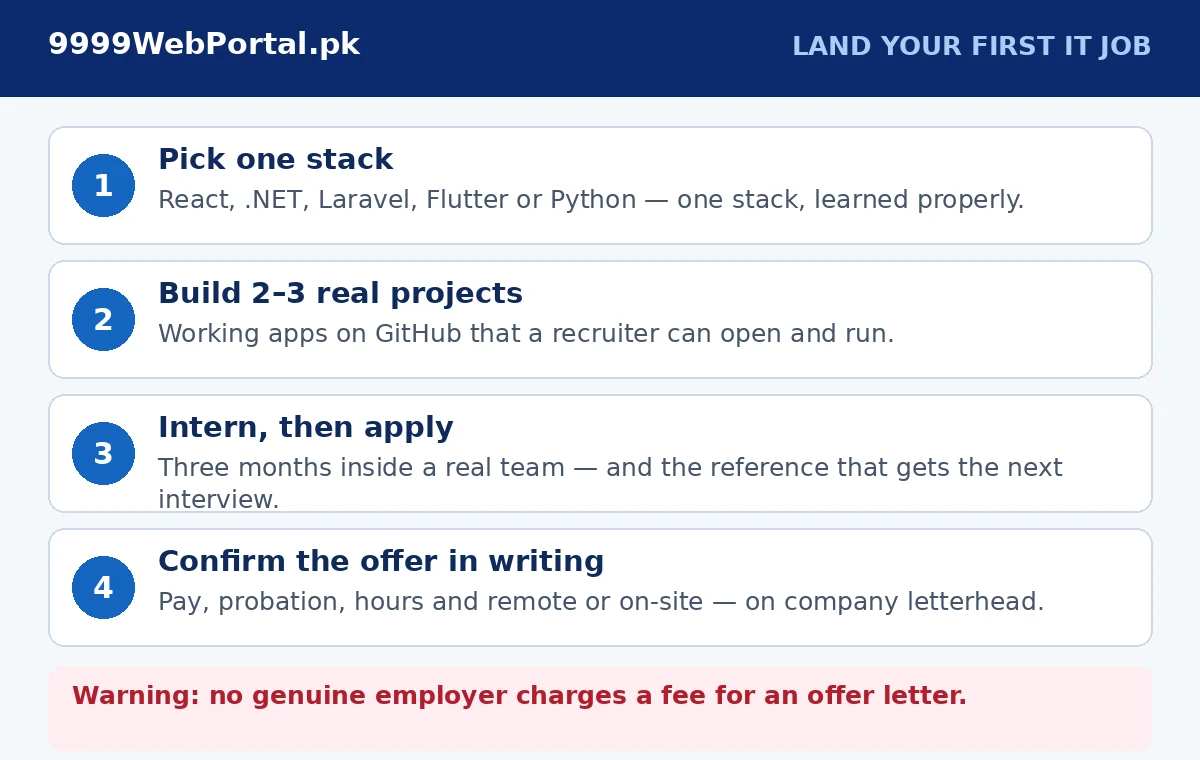
- Pick one stack and finish it. Frontend (React), backend (Node, .NET, Laravel or Java), mobile (Flutter) or data (Python) — one stack, learned properly, beats three half-learned ones. Employers hire depth.
- Build 2–3 real projects and put them on GitHub. A working CRUD app, a small e-commerce site, a Flutter app with real data — projects a recruiter can open and run. A GitHub profile with green activity and readable code is the single strongest signal a fresher can send.
- Take an internship, even a low-paid one. Most Lahore and Karachi software houses hire juniors from their own interns. Three months inside a real team — standups, code reviews, tickets — teaches more than a year of tutorials and gives you the reference that gets the next interview.
- Make a one-page CV and a LinkedIn profile that match. Stack, projects with links, internship, and the role you want — in plain English. Recruiters in Lahore search LinkedIn daily; a profile with no projects and no photo gets skipped.
- Apply where the jobs are. Rozee.pk and LinkedIn for salaried roles, ITJobsInPakistan for IT-specific listings, and the career pages of software houses directly — many Lahore houses post openings on their own sites before any job board. Apply within days of posting.
- Prepare for the two tests every IT employer runs. A coding or logic test (often on HackerRank or a live task) and a technical interview about your own projects. Revise your own code before the interview — “what did you build and why” is the question that decides it.
- Confirm the offer in writing. Monthly pay, probation period, working hours, remote or on-site, and notice period. A genuine offer letter comes on company letterhead or a company email — never as a WhatsApp message asking for a fee.
If you do not have a CS degree, this route still works: bootcamps, DigiSkills courses and self-taught portfolios get developers hired every year in Pakistan. The degree opens doors faster, especially in larger companies and government IT, but the portfolio is what survives the technical interview. What does not work is a certificate with no project behind it — employers stopped hiring certificates years ago.
Freelancing vs a Full-Time IT Job
| Full-time IT job | Freelancing | |
|---|---|---|
| Income | Fixed monthly salary, predictable from month one | Unpredictable at first; experienced freelancers often earn more per hour than salaried work |
| First 3 months | Paid from day one, with training and a team | Slow — profile building, first clients, first reviews; many earn little at the start |
| Learning | Code reviews, seniors, real production systems | You learn alone; faster in breadth, slower in depth |
| Benefits | Provident fund, leave, medical in larger companies | None — but full control of hours, clients and rates |
| Best for | Fresh graduates and anyone who needs steady income | Developers with 1–2 years of experience, a portfolio and reviews |
Most successful Pakistani IT freelancers did both in order: a full-time job first, freelancing on the side, and full-time freelancing only after the freelance income matched the salary for three months running. The country’s freelance numbers explain the appeal — $1.76 billion in FY26, with IT freelancing at $1.16 billion — but the honest per-person picture is sobering: spread across 2.3 to 3 million freelancers, the average is only a few hundred dollars a year, because the count includes part-timers and inactive accounts. The money is real, but it concentrates in the top slice of freelancers with reviews, repeat clients and a niche. If you want freelance income, our online jobs in USA for Pakistani guide and our remote jobs in USA from Pakistan guide explain how Pakistani freelancers win foreign clients.
PSEB Registration, Tax & Getting Paid
Three practical rules govern IT freelancers in Pakistan in 2026, and they are better than most freelancers realise.
- PSEB registration is free and worth doing. Registering with the Pakistan Software Export Board gives you a formal identity as an IT freelancer, which helps with banks, with getting your earnings recognised as IT exports, and with the concessional tax rate. It also makes you eligible for PSEB programmes — in 2026 PSEB launched its first-ever Top Freelancer Award as part of the IT Export Awards.
- Tax is 0.25% on IT export income. The final tax rate of 0.25% on IT and ITeS export income for PSEB-registered freelancers and companies has been extended to 2029. Keep your remittance records clean so the income is clearly export income.
- Getting paid got easier in April 2026. The State Bank’s reform package abolished Form R — the per-transaction declaration that used to accompany inward remittances — and replaced it with a one-time declaration, and freelancers can now retain up to 50% of their export proceeds in foreign currency in an Exporters’ Special Foreign Currency Account (ESFCA), spending it internationally without asking the central bank first. The remaining problem is unchanged: PayPal and Stripe still do not operate in Pakistan, so most freelancers are paid by direct bank transfer, Wise, or through Upwork and Fiverr’s own payout systems.
For salaried IT workers, tax is simpler: your employer deducts it at source. For freelancers, keep a separate bank record of every foreign payment, register with PSEB, and file with the 0.25% rate in mind — the difference between paying 0.25% and paying full income tax rates is the difference between a side income and a real business.
IT Job Scams & Fake Offers
- The paid offer letter: “Pay PKR 5,000–20,000 for your offer letter / laptop / training and the job is yours.” No genuine software house charges for an offer letter. The offer comes first, free, on company letterhead.
- The fake interview on WhatsApp: a “recruiter” who interviews only by chat, has no company email, and asks for your CNIC and bank details before any video call. Real IT hiring happens on company email, LinkedIn, or a video call with a named interviewer.
- The training-fee job: a “software house” that hires you, then asks you to pay for a compulsory training course before joining. Training inside a real job is paid for by the employer, not the employee.
- The overseas job with a visa fee: “IT job in Dubai/USA, pay the visa processing fee first.” Genuine foreign employers and licensed recruiters never ask for visa fees upfront from the worker; the fee request is the scam.
- The cloned company page: a Facebook page or website copying a real Lahore software house’s name and logo, posting fake openings. Check the company’s real website and LinkedIn page — the fake one always has a Gmail or WhatsApp contact instead of a company domain.
The rule is the same as for every other job in this guide: money flows from the employer to you, never from you to the employer. A job that asks you to pay to start is not a job.
خلاصہ (Urdu Summary)
پاکستان میں آئی ٹی نوکریاں 2026 میں ملک کی سب سے تیزی سے بڑھتی ہوئی کیریئر ہیں — آئی ٹی برآمدات تقریباً 4.6 ارب ڈالر کے ریکارڈ پر پہنچ گئی ہیں اور 23 لاکھ سے زیادہ پاکستانی فری لانسرز رجسٹرڈ ہیں۔ سافٹ ویئر انجینئر کی عام تنخواہ تقریباً 61 ہزار سے 166 ہزار روپے ماہانہ ہے، جونیئر 40 ہزار سے شروع کرتے ہیں اور سینئر انجینئر تقریباً ڈیڑھ لاکھ یا اس سے زیادہ کماتے ہیں۔ لاہور میں آئی ٹی نوکریاں سب سے زیادہ ہیں (56 فیصد)، اس کے بعد کراچی اور اسلام آباد ہیں۔ نوکری حاصل کرنے کے لیے ڈگری کے ساتھ ساتھ گٹ ہب پر 2 سے 3 اصلی پروجیکٹس اور انٹرن شپ سب سے اہم ہیں۔ فری لانسنگ کے لیے پی ایس ای بی رجسٹریشن کروائیں — آئی ٹی آمدنی پر ٹیکس صرف 0.25 فیصد ہے۔ کوئی اصلی کمپنی آفر لیٹر یا نوکری کے لیے فیس نہیں مانگتی۔
Frequently Asked Questions
What is the average IT salary in Pakistan in 2026?
A typical software engineer earns about PKR 61,000–166,000 a month (Glassdoor, October 2026), with an Indeed average of about PKR 92,828 from job adverts. Juniors start at PKR 40,000–115,000, mid-level engineers earn PKR 100,000–250,000, and seniors PKR 250,000–500,000 or more — with the top of each range in export-market companies and direct remote work.
Do I need a CS degree for IT jobs in Pakistan?
It helps, especially in larger companies and government IT, but it is not the only route. Bootcamps, DigiSkills courses and a self-taught GitHub portfolio get developers hired every year. What employers actually test is your code and your projects — a degree without a portfolio rarely survives the technical interview.
Which city pays the most for IT jobs in Pakistan?
Lahore has the most jobs (56%) and the highest median advertised pay at about PKR 85,000. Glassdoor data puts Karachi slightly ahead of Lahore at the typical level, while Indeed’s advert averages put Lahore first. The employer matters more than the city — an export-market team in any city pays more than a local agency.
How do I start freelancing in IT from Pakistan?
Build a portfolio on GitHub first, then create profiles on Upwork and Fiverr, take small jobs to earn reviews, and register with PSEB — registration is free and gives you the 0.25% final tax rate on IT export income plus formal freelancer status. Since April 2026 you can retain up to 50% of export earnings in foreign currency, but PayPal and Stripe still do not operate in Pakistan, so payments come by bank transfer, Wise or the platforms’ own payout systems.
What is PSEB registration and why does it matter?
The Pakistan Software Export Board registers IT companies and freelancers. Registration gives you formal recognition as an IT exporter, access to the 0.25% tax rate on IT export income (extended to 2029), and eligibility for PSEB programmes like the Top Freelancer Award launched in 2026. It is free and done online.
Can I get a remote IT job with a US or European company from Pakistan?
Yes — direct remote contracts pay 50–150% more than local employment for the same skill. You need a strong GitHub portfolio, fluent written English, and usually 1–2 years of experience first. LinkedIn, remote job boards and referrals are the main routes; beware of any “remote job” that asks for a fee before hiring.
Is AI replacing IT jobs in Pakistan?
AI is changing IT work, not ending it. Data, ML and AI engineering is now the fastest-growing and best-paid lane (PKR 70,000–130,000 starting, PKR 400,000–750,000 at senior level), and developers who use AI tools productively are more valuable, not less. Routine coding is getting automated; system design, client understanding and shipping real products are not.
What is the best first IT job for a fresh graduate?
A junior developer or QA role in a software house that trains its juniors — or an internship that converts to a job. QA, support and design roles are also real doors into IT: they pay PKR 40,000–85,000 to start and let you learn the stack from inside before moving into development.
Sources & How We Verified This Guide
Salary figures in this guide come from Glassdoor (October 2026, more than 7,700 reported software engineer salaries), Indeed job advert averages (November 2026), and ITJobsInPakistan’s analysis of 1,817 IT jobs posted between January and October 2026, including its Lahore–Islamabad pay comparison. Export and freelancer figures come from State Bank of Pakistan data reported by ProPakistani, Pakistan Today, Business Recorder and The Express Tribune in July–November 2026, and from Pakistan Software Export Board announcements, including the 0.25% tax rate extension and the Top Freelancer Award 2026. Pay varies by employer type, so always confirm the exact salary, shift and terms in the employer’s written offer before you start.
About 9999webportal.pk: we are an independent information website, not a government body. Spotted something out of date? Tell us through our contact page and we will update it.

Saim is the founder of 9999 Web Portal. He researches government portals, government jobs and online earning guides in Pakistan and verifies every guide against official sources before publishing.