
Quick answer: OPT jobs in the USA are jobs taken under Optional Practical Training — the work permission that lets an F-1 student work in the United States in a job directly related to their degree, for up to 12 months after graduation. STEM graduates can add a 24-month extension, for 36 months in total. No employer sponsors your OPT — you apply yourself to USCIS on Form I-765, and you may not start work until your Employment Authorization Document (EAD) arrives. The hard limits are the 90-day unemployment rule and the filing window: up to 90 days before you finish, and no later than 60 days after. As of 28 November 2026 the fee is $470 online or $520 on paper, and a record 335,785 international students were working on OPT in 2025/26 — including 14,340 from Pakistan.
| OPT jobs in USA: at a glance | |
|---|---|
| What it is | Optional Practical Training — temporary work permission for F-1 students, in a job directly related to their major |
| How long | 12 months per degree level; 24-month STEM extension (36 months total) |
| Who can apply | F-1 students enrolled full-time for at least one full academic year at a SEVP-certified school, in valid F-1 status |
| How to apply | DSO recommends OPT in SEVIS and issues a new I-20; you file Form I-765 with USCIS and pay the fee |
| Cost | $470 online or $520 on paper; premium processing $1,780 (optional) |
| Unemployment limit | 90 days in total on post-completion OPT; 150 days in total across OPT plus the STEM extension |
| After OPT | H-1B through an employer, a new degree, another status, or leave within the 60-day grace period |
Last updated: 28 November 2026. OPT rules, fees and deadlines were checked on the official USCIS OPT page on 28 November 2026. Salary figures are 2026 entry-level medians, labelled as estimates.
Every year, hundreds of thousands of international students stay in the United States after graduation to work in the field they studied — and for most of them, OPT is the only route that makes it possible. It is not a visa and it is not a job offer: it is a work permission attached to your F-1 student status, granted by USCIS, that lets you take a paid job related to your degree. This guide gives you the honest picture for 2026. Our guides to remote jobs in the USA from Pakistan, online jobs in the USA for Pakistanis and online teaching jobs in the USA from Pakistan cover the routes you can take without a US degree — this one is for students already studying, or planning to study, in America.
9999webportal.pk is an independent information website, not an immigration adviser and not part of USCIS. This guide is general information, not legal advice — always confirm deadlines with your DSO and the official USCIS OPT page before you file anything.
In this guide:
- What Is OPT? The Honest Picture for 2026
- Who Can Apply for OPT? Eligibility Rules
- Pre-Completion OPT vs Post-Completion OPT
- The 24-Month STEM OPT Extension
- How to Apply for OPT, Step by Step
- The 90-Day Unemployment Rule
- OPT Jobs & Salaries by Field
- Where to Find OPT Jobs in the USA
- From OPT to H-1B: Cap-Gap & the 2026 Changes
- OPT for Pakistani Students: What to Know
- OPT Job Scams — How to Spot Them
- خلاصہ (Urdu Summary)
- Frequently Asked Questions
What Is OPT? The Honest Picture for 2026
Optional Practical Training is temporary employment that is directly related to an F-1 student’s major area of study. That one sentence, from USCIS itself, carries the three rules that decide everything else: the work must be temporary, it must be directly related to what you studied, and it is granted to F-1 students. It is not a separate visa, and no employer petitions for it on your behalf — you apply for it yourself.
You can receive up to 12 months of OPT at each education level — bachelor’s, master’s and PhD each get their own period. The work can be full-time or part-time, and you can change employers as often as you like, provided each job is related to your field. While you are on OPT you are still an F-1 student: your school still holds your SEVIS record, and your DSO remains your first point of contact. OPT is generous but narrow — no job offer, no sponsor and no labour market test, but the job must match your degree. The Open Doors 2026 report counted a record 335,785 international students working on OPT in 2025/26, up 14.1% on the year before.
Who Can Apply for OPT? Eligibility Rules
You must be an F-1 student, enrolled full-time for at least one full academic year at a school certified by the Student and Exchange Visitor Program (SEVP), maintaining your F-1 status, and the work must be directly related to your major. You do not need to have held F-1 status for the whole year — time in another nonimmigrant status can count, as long as you were lawfully enrolled full-time.
Two points catch people out. First, you do not need a job offer before you apply — many wait for one and lose months. Second, OPT is granted per education level, and transferring schools or starting a new degree level ends your current OPT. Also note that 12 months of full-time Curricular Practical Training (CPT) at the same level removes OPT eligibility at that level, while part-time CPT does not.
| Requirement | The rule |
|---|---|
| Status | F-1 student, maintaining valid F-1 status |
| Enrolment | Full-time for at least one full academic year at a SEVP-certified school |
| Job offer | Not required for the initial 12-month OPT |
| Job match | Work must be directly related to your major area of study |
| Hours | Pre-completion: 20 hours or less a week in term; full-time in breaks. Post-completion: at least 20 hours a week |
| How long | Up to 12 months per education level; 24-month STEM extension for qualifying degrees |
Pre-Completion OPT vs Post-Completion OPT
OPT comes in two forms — pre-completion (before you finish your degree) and post-completion (after it) — sharing one 12-month allowance per level.
Pre-completion OPT is available after one full academic year: 20 hours a week or less in term, full-time in breaks. Part-time pre-completion OPT is deducted at half rate — one year of it costs six months of post-completion OPT — while full-time pre-completion OPT is deducted month for month. A student who used one year of full-time pre-completion OPT has none left at that level.
Post-completion OPT is the standard route: you apply near the end of your programme, and once approved you must work at least 20 hours a week in a job related to your degree. Your start date can be as early as the day after you complete your programme, or as late as 60 days after it — but the 12 months are counted from the start date on your EAD, not from the day you find a job. Most DSOs advise a start date a few weeks after graduation. For almost every student, post-completion OPT is the right choice; CPT usually covers internships better, because it does not eat into your 12 months unless it reaches a full year of full-time work.
The 24-Month STEM OPT Extension
If your degree is in science, technology, engineering or mathematics, you can apply for a 24-month extension — 36 months of work authorisation in total. It is the single most valuable difference between a STEM and a non-STEM degree: three chances at the H-1B lottery instead of one.
The conditions are stricter: a degree on the DHS STEM list, an employer using E-Verify, at least 20 hours a week in a paid job, and a completed Form I-983 training plan. You cannot be self-employed on STEM OPT, and you cannot be the sole owner of the business that employs you. Two STEM extensions are possible in a lifetime, at successively higher levels.
You may apply up to 90 days before your current OPT authorisation expires, and USCIS must receive your application within 60 days of your DSO entering the recommendation in SEVIS — and no later than your current OPT end date. File on time and your work authorisation is automatically extended for up to 180 days while USCIS decides; file late and that protection disappears. STEM OPT also adds reporting duties: report changes within 10 days and confirm your details with your DSO every six months.
How to Apply for OPT, Step by Step
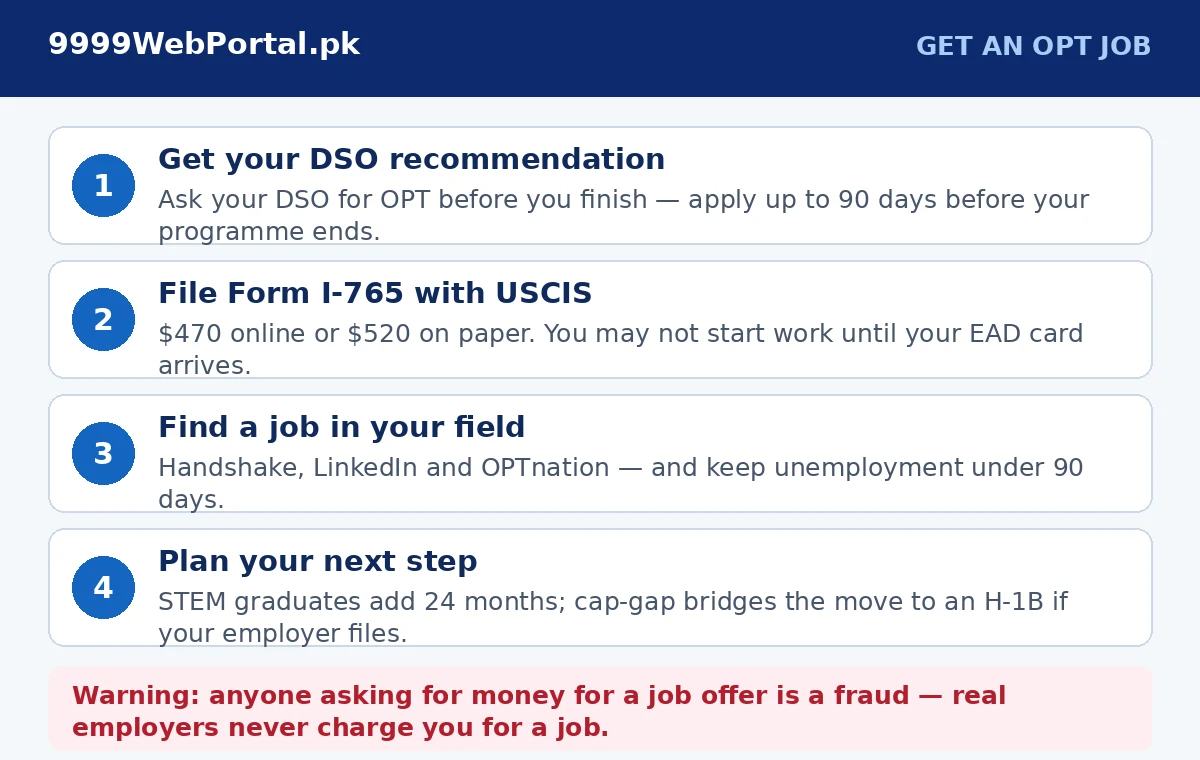
OPT is a two-part application: your school recommends it, and USCIS grants it. USCIS will not accept your Form I-765 until your DSO has entered the recommendation in SEVIS.
- Attend your school’s OPT workshop before your final semester and confirm your programme end date, OPT start date and the current form edition with your DSO.
- Ask your DSO to recommend OPT — your DSO endorses your Form I-20 and issues a new one.
- File Form I-765 within 30 days of the recommendation — the clock starts when your DSO enters it in SEVIS. File online through myUSCIS if you can — you get a receipt immediately.
- Pay the fee and keep the receipt. Optional premium processing (Form I-907) costs $1,780 more and commits USCIS to respond within 30 business days.
- Wait for the EAD — and do not work before it arrives. In early November 2026 about 80% of OPT applications were completed within 5 months, so file early.
- Report your job to your DSO within 10 days of starting — employer, job title, start date and how it relates to your degree. On STEM OPT, a new employer means a new Form I-983 within 10 days.
| OPT cost (as of 28 Nov 2026) | Amount |
|---|---|
| Form I-765, online filing | $470 |
| Form I-765, paper filing | $520 |
| Premium processing, Form I-907 (optional) | $1,780 — decision within 30 business days |
| Online filing + premium processing | $2,250 in total |
As of 19 November 2026, USCIS accepts the 08/21/25 edition of Form I-765 and not the 09/15/26 edition. Always download the form from the USCIS website on the day you file — an old edition is a common reason for rejection.
The 90-Day Unemployment Rule
This is the rule that ends more OPT periods than any other. During post-completion OPT you may not be unemployed for more than 90 days in total, counted together across the whole period, from the start date printed on your EAD. Reach 90 days and you are in violation of your F-1 status — finding a job on day 91 does not fix it.
With a STEM extension, the limit rises to 150 days in total across the full 36 months, including whatever you used in the first 12 months. The rule is in the federal regulations at 8 CFR 214.2(f)(10)(ii)(E).
Part-time work of at least 20 hours a week in your field counts as employment, and jobs can be combined. On standard OPT, unpaid work in your field can count too, if you work at least 20 hours a week and can document it. On STEM OPT the job must be paid, at least 20 hours a week, with the employer that signed your Form I-983. Treat the first 90 days as a job-search budget: start applying in your final semester.
OPT Jobs & Salaries by Field
OPT pay depends far more on your field than on your university. The table below uses the College Recruiter 2026 Early Career Compensation Index — national median starting salaries for entry-level roles. These are medians for all new graduates, not OPT-specific offers — so treat them as a guide, not a promise.
| Field (entry-level roles) | Median starting salary (USA, 2026) | Typical range |
|---|---|---|
| Computer science & software engineering | $88,000 a year | $74,000–$108,000 |
| Data science, AI & analytics | $81,000 a year | $69,000–$96,000 |
| Engineering (mechanical, electrical, hardware) | $78,000 a year | $68,000–$90,000 |
| Finance & accounting | $74,000 a year | $63,000–$88,000 |
| Healthcare & nursing (BSN) | $72,000 a year | $62,000–$84,000 |
Across all majors, the national median starting salary for a new bachelor’s graduate in 2026 is about $62,500. Location changes everything: the same software job pays 15–30% more in San Francisco or New York, and 10–20% less in smaller cities — but the rent there is often half. A first job related to your degree is worth more than a higher-paying unrelated one, because an unrelated job does not count as OPT employment at all. Entry-level hiring is tight: on 9 November 2026 only about 6% of 37,031 open US tech jobs were open to beginners.
Where to Find OPT Jobs in the USA
The best place to look is not a general job board — it is the places that already know what OPT is. A company that has hired OPT students before knows that hiring you costs them nothing in immigration fees; one that has never heard of OPT will often reject you by mistake, assuming you need sponsorship on day one.
- Handshake — your university’s career platform — the strongest starting point. Use the “Accepts OPT/CPT” and “Will Sponsor” filters.
- Interstride — built for international students.
- LinkedIn and Indeed — search with the keywords “OPT”, “entry-level” and “F-1 visa”.
- OPT-specific portals — OPTnation, MyOPTJobs and UnitedOPT list roles curated for F-1 students.
- MyVisaJobs — before accepting an offer, check whether the employer has a real record of H-1B sponsorship.
- Your university career centre and alumni network — employers that recruited at your school last year will recruit there again.
- Employer career pages, direct — employers that regularly hire OPT graduates include Google, Microsoft, Amazon, Meta, Intel, IBM, Tesla, GE, Boeing, Siemens, Goldman Sachs, Deloitte, PwC, Bank of America, J&J, Pfizer and Mayo Clinic.
Two habits separate the students who find work from those who do not. First, say “OPT” plainly to every recruiter — “I am authorised to work in the US on OPT until [date], and I do not need sponsorship now” — because silence makes recruiters guess, and they usually guess wrong. Second, apply widely and early, from January of your final year.
From OPT to H-1B: Cap-Gap & the 2026 Changes
For most OPT graduates, the real goal is a longer stay, and that usually means H-1B — an employer-sponsored work visa with an annual cap. The calendar creates a gap: your OPT often ends in spring or summer, but an H-1B cannot start before 1 October, the first day of the federal fiscal year. Cap-gap is the regulation that bridges those months.
If your employer files a timely cap-subject H-1B petition for you, requesting a change of status, while you are still in valid F-1 status, your status — and your work authorisation, if your OPT was still unexpired — is extended automatically. You file nothing for cap-gap; your proof is an updated I-20 from your DSO. Since 17 January 2025 the extension runs until your approved H-1B start date or 1 April of the fiscal year, whichever comes first. Filed during your 60-day grace period, only your status extends. And do not travel internationally during cap-gap: leaving can abandon the change-of-status request.
The H-1B lottery changed for FY2027: DHS replaced random selection with selection weighted by wage level — the higher the wage, the better the chance. The rule took effect on 27 February 2026.
Proclamation 10973 (19 September 2025) required a $100,000 payment with certain new H-1B petitions — but USCIS guidance said it applied only to petitions for people outside the United States, not to change-of-status petitions inside the country. Then, on 8 June 2026, a federal court vacated the policy, the First Circuit refused to pause that ruling on 24 July 2026, and USCIS confirmed it is not collecting the fee. A separate DHS proposal of 25 August 2026 for a $103,265 fee on every cap-subject petition is only a proposal, with no effective date.
Duration of status still applies: a DHS rule that would have replaced it was vacated by a federal court on 16 November 2026. When OPT ends, a 60-day grace period follows in which you may stay but not work; your options then are H-1B, a new degree, another status, or departure — and a new degree is the most reliable backup, entirely within your control.
OPT for Pakistani Students: What to Know
Pakistan is now the 12th largest source of international students in the United States: 14,340 in 2025/26, up 8.9% on the year before — a new record. The previous year’s 13,165 included 2,517 students already working on OPT.
Nothing in the OPT rules is different for Pakistani students — eligibility, deadlines and fees are the same for every nationality. But a few practical points matter. First, OPT itself needs no US visa: you are already in the United States on an F-1 visa. The visa only matters if you travel abroad during OPT — then you need a valid F-1 visa stamp, your EAD card, and an I-20 signed for travel within the last six months. Many students avoid travel during OPT entirely.
Second, think about money early: get a Social Security number as soon as your EAD arrives, and open a US bank account. F-1 students are generally treated as nonresident aliens for tax purposes for their first five calendar years, which usually means exemption from Social Security and Medicare taxes, but you still pay federal and state income tax, and you must file a tax return. Third, the fields that pay best on OPT — computer science, data science and engineering — also carry the 24-month STEM extension. If you are choosing a master’s now, a STEM degree is worth more than a small difference in ranking, because it triples your work authorisation and your H-1B chances. Check the programme’s CIP code against the DHS STEM list before you enrol. See also our guide to jobs in Dubai for Pakistanis.
OPT Job Scams — How to Spot Them
OPT students are a favourite target for job scams, because you are new to the country, under a deadline, and worried about the 90-day rule. In real hiring, the money goes one way only — the employer pays you, and you never pay the employer or any agent for the job itself.
- The paid job offer. A “consultancy” offers you an OPT job for a fee — often $2,000–$5,000. A real employer pays you; a fake employer on your record can end your OPT.
- The fake training plan. On STEM OPT, someone offers to sign your Form I-983 for a fee, without a real job behind it. A false I-983 can cost you your status.
- The benching scam. A staffing firm hires you, then leaves you “on the bench” — unpaid, waiting for a project — while your unemployment days run out.
- The sponsorship promise. An employer promises H-1B sponsorship, then never files — check its record on MyVisaJobs first.
- The fee for the EAD. Nobody but USCIS can issue your EAD ($470 online or $520 on paper). Only premium processing through USCIS speeds things up, for $1,780.
- The identity harvest. A “recruiter” asks for your passport copy, I-20 or bank details before any interview. A real employer asks only after an offer, never by email or WhatsApp.
Unsure about an offer? Take it to your DSO or career centre before you sign or pay anything — both are free.
خلاصہ (Urdu Summary)
او پی ٹی (Optional Practical Training) امریکہ میں ایف ون طلبہ کے لیے کام کرنے کی اجازت ہے — گریجویشن کے بعد اپنی ڈگری سے متعلقہ نوکری، 12 ماہ کے لیے۔ سٹیم (STEM) ڈگری والوں کو 24 ماہ کی توسیع ملتی ہے، یعنی کل 36 ماہ۔ درخواست کے لیے نوکری کی پیشکش ضروری نہیں؛ آپ خود USCIS کو فارم I-765 بھیجتے ہیں، فیس 470 ڈالر آن لائن یا 520 ڈالر کاغذ پر ہے، اور کام صرف EAD کارڈ ملنے کے بعد شروع کر سکتے ہیں۔ 90 دن سے زیادہ بے روزگار نہیں رہ سکتے — سٹیم کے ساتھ کل حد 150 دن ہے۔ درخواست گریجویشن سے 90 دن پہلے سے 60 دن بعد تک دی جا سکتی ہے۔ 2025/26 میں 335,785 طلبہ او پی ٹی پر تھے، جن میں پاکستان کے 14,340 تھے۔ جو شخص نوکری کے لیے پیسے مانگے وہ فراڈ ہے۔
Frequently Asked Questions
What is OPT, and how long does it last?
Work permission for F-1 students in a job directly related to their degree: up to 12 months per level, plus a 24-month STEM extension (36 months total).
Do I need a job offer to apply for OPT?
No. You apply yourself to USCIS on Form I-765, and look for the job while it is processed.
How much does OPT cost in 2026?
Form I-765 costs $470 online or $520 on paper, plus $1,780 for optional premium processing. A proposed $70,000 OPT fee is not law.
What is the 90-day unemployment rule on OPT?
No more than 90 days in total on post-completion OPT — 150 days with a STEM extension. Going over violates your F-1 status.
Can I work on OPT before my EAD card arrives?
No. You may not work until USCIS approves your Form I-765 and you hold the EAD — so file early.
What is the STEM OPT extension, and who qualifies?
Graduates with a DHS-listed STEM degree can extend OPT by 24 months. Your employer must use E-Verify and sign a Form I-983, and you must work 20+ hours a week in a paid job.
Does OPT lead to an H-1B visa?
OPT does not give you an H-1B, but it gives you time to get one: your employer enters you in the lottery, and cap-gap extends your status while a timely petition is pending.
Is the $100,000 H-1B fee a problem for OPT students?
No. It never applied to change-of-status petitions inside the USA, and a federal court vacated the policy in June 2026 — USCIS is not collecting it.
Sources & How We Verified This Guide
OPT rules, deadlines, fees and the STEM extension come from the official USCIS page “Optional Practical Training (OPT) for F-1 Students” (uscis.gov), opened and read on 28 November 2026. Unemployment limits are in the federal regulations at 8 CFR 214.2(f)(10)(ii)(E). Fees are the USCIS fee schedule as in force on 28 November 2026: Form I-765 $470 online / $520 paper, premium processing $1,780 since 1 March 2026. Processing times (about 80% of cases within 5 months, early November 2026) come from USCIS processing-time data. Student numbers come from the IIE Open Doors 2026 report: 1,146,163 international students in 2025/26, a record 335,785 on OPT, and 14,340 from Pakistan. Salary figures are the College Recruiter 2026 Early Career Compensation Index and NACE projections, labelled as estimates. The 2026 changes were checked against November 2026 legal reporting. Where a rule is only proposed, the article says so; where a figure is an estimate, it is labelled as one.
About 9999webportal.pk: we are an independent information website, not a government body. Spotted something out of date? Tell us through our contact page and we will update it.

Saim is the founder of 9999 Web Portal. He researches government portals, government jobs and online earning guides in Pakistan and verifies every guide against official sources before publishing.