
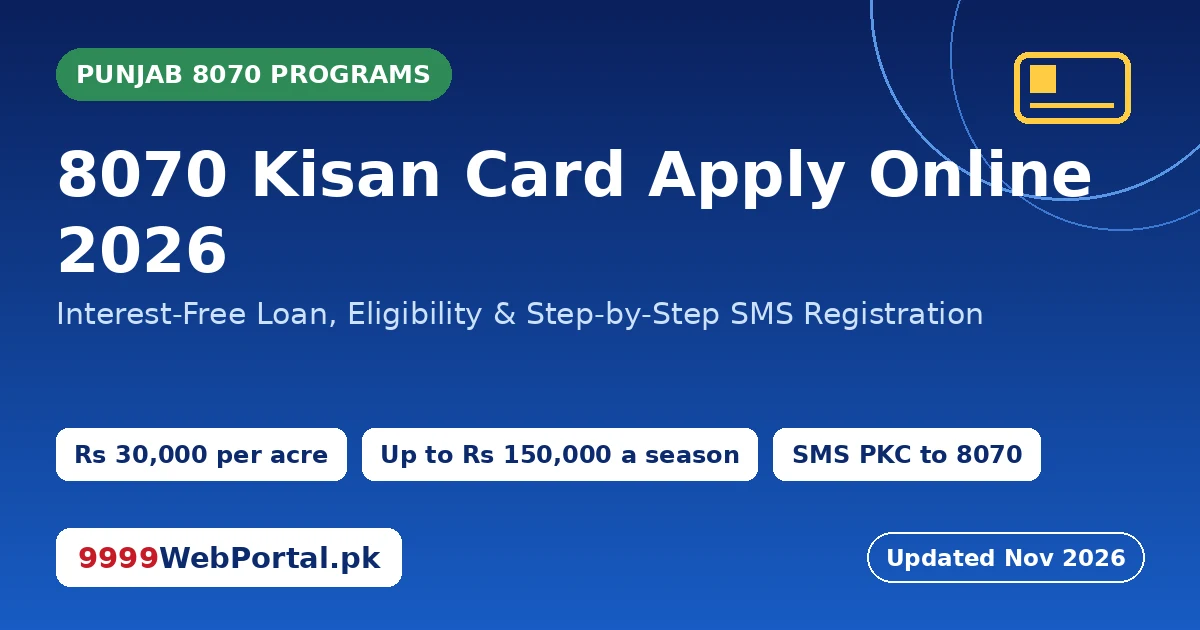
Quick answer: The 8070 Kisan Card (officially the CM Punjab Kissan Card) is the Punjab government’s interest-free seasonal loan card for small farmers, issued by the Bank of Punjab. If you own 1 to 12.5 acres recorded with the Punjab Land Records Authority (PLRA), send one SMS: type PKC, a space and your 13-digit CNIC number, to 8070 from a SIM registered in your own name. There is no online web form and no fee to apply. The card gives up to Rs 30,000 per acre (up to Rs 150,000 a season) for seed, fertiliser and pesticide from registered dealers, repayable within six months plus a one-month grace period. On 28 October 2026 the Chief Minister raised the limit for DAP fertiliser to Rs 33,500 per acre for the wheat season. Anyone charging you for registration or a card is a fraud.
| 8070 Kisan Card: at a glance | |
|---|---|
| Scheme | CM Punjab Kissan Card — Punjab Agriculture Department with PITB |
| How to apply | SMS PKC, a space and your CNIC number, to 8070 from your own SIM |
| Who can apply | Punjab farmers with 1 to 12.5 acres in the PLRA record |
| Loan | Interest-free; Rs 30,000 per acre, up to Rs 150,000 a season |
| Card validity | Six months, with a one-month grace period to repay |
| Issued by | Bank of Punjab, after NADRA, PMD and e-CIB credit checks |
| What it buys | Seed, fertiliser and pesticide from registered dealers |
| Fee to apply | None — the official pages say there is no processing fee |
| Helplines | Agriculture Department 0800-17000; Bank of Punjab card activation 042-111-333-267 |
Last updated: 29 November 2026. Scheme terms were checked on the official Punjab Portal scheme page and the Agriculture South Punjab scheme page on 29 November 2026; the October–November 2026 announcements are from Dawn and the Associated Press of Pakistan.
Punjab’s wheat season is under way — the province targets 16.5 million acres for Rabi 2026–27 — and the Kisan Card is how small farmers are buying their seed and fertiliser. Yet the card confuses people: is there an online form, does it cost anything, why do some farmers get rejected? This guide answers all of it from the official scheme pages. Our guides to the 8070 web portal, PSER registration and the 8070 Ramzan Package explain the other programmes on the same 8070 channel.
9999webportal.pk is an independent information website, not a government body and not part of the Punjab Agriculture Department or the Bank of Punjab. We do not take applications or fees for any scheme. Always apply through the official SMS route and the official scheme page.
In this guide:
- What Is the 8070 Kisan Card?
- Kisan Card Loan Limits & What the Card Pays For
- The October 2026 Changes: DAP Limit, Wheat Support & Apna Kisan Bank
- Who Can Apply: Eligibility
- Documents & Records You Need Before You Apply
- How to Apply Online, Step by Step
- After You Apply: Verification, Card Collection & Activation
- How to Use the Card at Registered Dealers
- Repayment: Six Months, Grace Period & the Next Season
- How to Check Your Kisan Card Application Status
- Kisan Card & PSER: How the 8070 Programmes Connect
- Other Benefits on the Same Card
- Common Rejections & How to Fix Them
- Kisan Card Scams — How to Spot Them
- خلاصہ (Urdu Summary)
- Frequently Asked Questions
What Is the 8070 Kisan Card?
The Kisan Card is a government-issued smart card that works as a seasonal, interest-free credit line for buying farm inputs. Officially the CM Punjab Kissan Card, it was approved by Chief Minister Maryam Nawaz on 29 March 2024 as the “Muhammad Nawaz Sharif Kissan Card”, with Rs 150 billion in loans promised to 500,000 small farmers in a year. Registration opened on 1 June 2024, and reported enrolment passed 832,000 farmers by June 2026.
The card runs on a digital system built by the Agriculture Department with the Punjab Information Technology Board (PITB). Your record is checked automatically against four databases: the PLRA for your land, NADRA for your identity, the PMD system for your SIM, and the e-CIB bureau for bank defaults. If you pass, the Bank of Punjab issues the card. It works like a debit card at registered dealers: you pay, the bank settles the dealer, and you repay the same amount after harvest. No interest is charged. The government spells it “Kissan Card”; “8070” is the SMS shortcode, not a separate scheme.
Kisan Card Loan Limits & What the Card Pays For
The loan is simple: Rs 30,000 of interest-free credit per acre, up to a season cap of Rs 150,000 per farmer per season — five acres at Rs 30,000 an acre. The card is valid for six months, covering one crop season, with a one-month grace period to repay, and it can only buy inputs from authorised vendors.
| Item | Launch terms (Punjab Portal) | Later phases (Agriculture South Punjab) |
|---|---|---|
| Credit per acre | Rs 30,000 | Rs 30,000 |
| Season cap per farmer | Rs 150,000 | Up to Rs 300,000 |
| Landholding | 1 to 12.5 acres | 1 to 25 acres |
| Interest | 0% — fully interest-free | 0% — fully interest-free |
| Validity | 6 months + 1 month grace | 6 months to repay |
The two official pages disagree on the cap. The Punjab Portal page still shows Rs 150,000 a season and 12.5 acres. The Agriculture South Punjab page, updated in July 2025, shows loans of up to Rs 300,000 per crop season and land of 1 to 25 acres, with a split of 30% cash, 20% diesel at registered PSO pumps and 50% inputs from registered vendors. The per-acre rate of Rs 30,000 is the same everywhere — confirm your own live limit on 0800-17000 before buying inputs.
The October 2026 Changes: DAP Limit, Wheat Support & Apna Kisan Bank
On 28 October 2026, Chief Minister Maryam Nawaz announced the province’s first “Apna Kisan Bank” and agricultural loans worth Rs 17 billion. The Kisan Card loan limit for buying DAP (diammonium phosphate) fertiliser was raised by Rs 3,500 per acre — from Rs 30,000 to Rs 33,500 per acre — reported by Dawn on 29 October 2026. Reports do not say whether Rs 33,500 is the new whole limit or a DAP-only addition, or whether the cap changes — confirm your cap with the bank.
The same announcement set the wheat support price at Rs 4,500 per maund for the 2027 crop, up from Rs 3,500. At a review meeting on 4–5 November 2026, Agriculture Minister Syed Ashiq Hussain Kirmani announced a wheat target of 16.5 million acres for Rabi 2026–27, Rs 150 billion allocated under the Kisan Card, and Rs 425 billion in interest-free loans disbursed over the past two and a half years. The Apna Kisan Bank itself is a proposal, not a working bank yet: it would offer loans of up to Rs 10 million at zero markup, up to Rs 30 million at 2% and up to Rs 50 million at 5% — a separate product, not Kisan Card credit. The announced extension to tenant farmers is also not yet the rule.
Who Can Apply: Eligibility
Eligibility is checked by computer against government databases — there is no interview. The Punjab Portal page lists three conditions: land up to 12.5 acres, a SIM registered against your own CNIC and PMD-verified, and a land record in the PLRA system. The South Punjab page, reflecting later phases, lists 1 to 25 acres, a valid CNIC, an updated PLRA record and a SIM in your own name.
| Requirement | What it means in practice |
|---|---|
| Punjab farmer | You farm in Punjab; this is a Punjab government programme |
| Landholding | 1 to 12.5 acres; 1 to 25 acres in later phases |
| Land record | Land already in the PLRA system, in your own name |
| CNIC | Valid, unexpired CNIC |
| SIM | Registered against your own CNIC, PMD-verified |
| Credit record | No bank or microfinance default — the e-CIB check will catch one |
Bank defaulters are excluded, and farmers with no PLRA land record cannot pass verification. If the land is still in a parent’s name, the card cannot be linked to you until the inheritance mutation is done — the single commonest reason applications fail. Tenant farmers are not covered under the live rules, and farmers with more than 25 acres are outside the scheme.
Documents & Records You Need Before You Apply
The SMS asks for nothing but your CNIC number — but verification runs on records you must already have in order. Get these right first: a failed check means a rejected application.
- Valid CNIC: your original, unexpired card. Text the 13 digits without dashes.
- SIM in your own name: registered against your own CNIC and PMD-verified. A family member’s SIM will fail.
- Land record in PLRA: your Fard-e-Malkiyat showing the land in your own name. If the record has an error, correct it at your nearest Land Record Centre first — verification reads the PLRA database, not a paper fard.
- Clean credit record: no outstanding default with any bank or microfinance institution — the e-CIB check runs automatically, so settle old loans first.
- Your own mobile phone: all SMS alerts go to the registered number, so keep it active and in your own hands.
You do not need to upload documents, and you do not need a bank account in advance. When you collect the card, bring your original CNIC for biometric verification.
How to Apply Online, Step by Step
There is no online web form for the Kisan Card: the Punjab Portal scheme page gives exactly one method — an SMS. Any website showing a “Kisan Card online apply form” and asking for your CNIC, photographs or bank details is not the government.
- Check your records first. Confirm your land is in the PLRA system in your own name and your SIM is registered against your own CNIC.
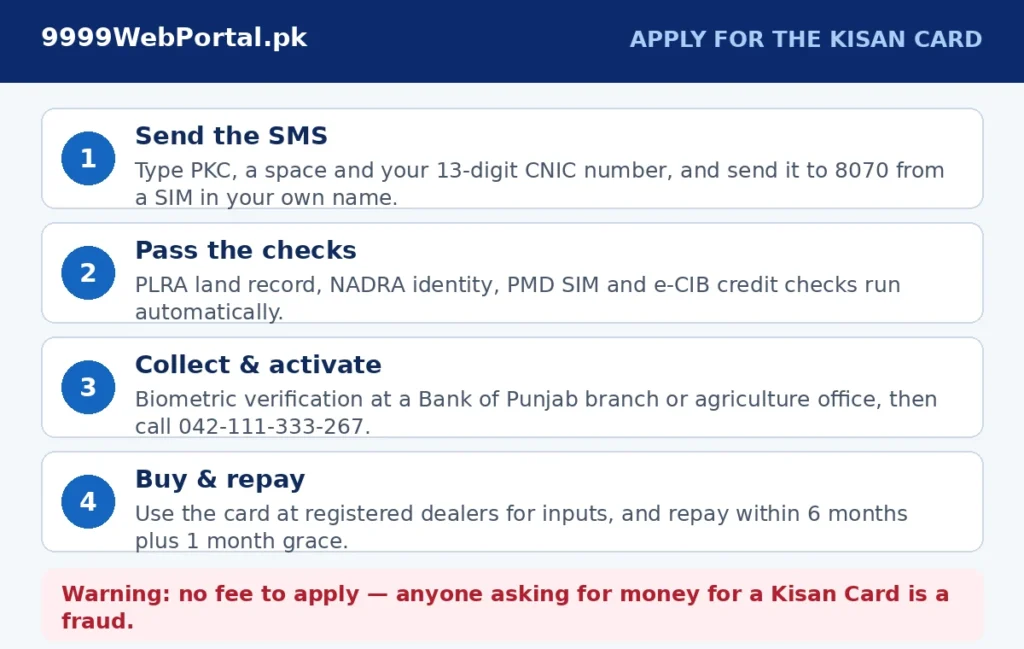
- Send the SMS. Open the messaging app on the phone with your own SIM. Type PKC, one space, then your 13-digit CNIC number without dashes — for example, PKC 3520212345678 (use your own number). Send it to 8070. There is no fee beyond your normal SMS charge.
- Wait for the reply. You will receive a confirmation message, then a reply about your eligibility. Keep the reply safe — it is your proof of application. If no reply comes within a few days, call 0800-17000 rather than sending the SMS again.
- Complete biometric verification. If you qualify, you will be told where to go — your nearest Bank of Punjab branch or agriculture office — with your original CNIC.
- Collect and activate the card. Once verification is complete, the Bank of Punjab issues your card. Collect it where directed, then activate it (see the next section).
After You Apply: Verification, Card Collection & Activation
Once your SMS reaches 8070, four checks run: the PLRA verifies your land record, NADRA verifies your identity, the PMD check confirms the SIM is registered in your name, and the e-CIB check looks for any bank default. If all four pass, the Bank of Punjab issues the card and you receive an SMS or a call telling you it is ready.
Collection depends on your district: the South Punjab page says to visit your nearest agriculture office after the call or SMS for biometric verification; other guides say a designated Bank of Punjab branch. Either way, take your original CNIC.
Activate by phone: call the Bank of Punjab helpline on 042-111-333-267 from your registered number. The representative will ask for your CNIC number, name, date of birth, mother’s name, birth district and the 16-digit card number. Keep the card number private. If you lose the card, forget the PIN or it is blocked, the Agriculture Department’s help desks can help.
How to Use the Card at Registered Dealers
The card is not cash, and it works only at registered dealers — the South Punjab page publishes district-wise lists. Check the dealer is on the list before you buy; a purchase from an unregistered shop will not go through.
At the shop, you pay with the card at the dealer’s terminal and the bank settles the dealer directly. Under the original terms, the whole limit is for inputs only. Under the later-phase terms, the limit splits into 30% cash, 20% diesel at registered PSO pumps and 50% inputs from registered vendors — ask the bank which version your card carries. Every transaction triggers a free SMS notification to your registered number. Buy from registered dealers only: the scheme was partly designed to protect farmers from fake fertiliser and fake seed.
Repayment: Six Months, Grace Period & the Next Season
The loan runs from sowing to harvest. The card is valid for six months, with a one-month grace period to repay. You repay exactly what you spent — no interest, no markup. Pay at a Bank of Punjab branch with a deposit slip, by online transfer to the card’s linked account, or through Raast ID.
Repaying on time matters, because the card is a revolving facility. The next season’s loan is transferred within 48 hours of paying the bill, and timely repayers enter reward draws — Phase IV held a lucky draw on 22 October 2026 (ballot KC4001). Overdue payments block the next cycle’s credit and exclude you from the draws. If you cannot repay by the due date, go to your bank branch or agriculture office before the deadline: an ignored overdue loan becomes a default on the e-CIB record.
How to Check Your Kisan Card Application Status
There is no single official web page where you can type your CNIC and see your Kisan Card status — and any website claiming to be one is not the government. Status comes through the same channels as the application. First, the SMS replies are the official record of your application; keep both. Second, call 0800-17000 from your registered number with your CNIC ready. Third, your nearest agriculture office can check your record. Fourth, your Bank of Punjab branch can confirm whether your card has been issued and what your limit is. Some guides claim the 8171 portal shows Kisan Card status — we could not verify that on any official source. Our guide to the 8171 web portal explains what it actually checks.
Kisan Card & PSER: How the 8070 Programmes Connect
The Kisan Card and PSER (the Punjab Socio-Economic Registry) are often mentioned together, but the connection is narrower than many guides claim. PSER is the Punjab government’s household database: survey teams collect household data across all 36 districts, and the resulting PMT score decides who qualifies for the cash programmes — the Ramzan Package, Rashan support and similar schemes. Register at pser.punjab.gov.pk, at a registration centre, or through the door-to-door survey, free. Our guide to PSER registration explains the process.
For the Kisan Card, the official scheme page does not list PSER registration as a requirement. The card’s own checks are the PLRA land record, NADRA identity, PMD SIM verification and the e-CIB credit check — a farmer can qualify on those four alone. The two systems share the 8070 channel and the same PITB backbone, and a household already in PSER will find its basic data already on file. In short: if you farm, apply for the card by SMS to 8070; if your household also wants the cash programmes, register in PSER as well — the two registrations are separate. Our guide to 8070 registration online explains the difference.
Other Benefits on the Same Card
The card is also the channel for several Punjab farm subsidies. The Agriculture South Punjab page lists the wheat subsidy — Rs 5,000 per acre for wheat growers, credited directly to Kisan Card holders in the financial year 2024–25 — alongside the Green Tractor Scheme for subsidised tractors, solar tubewell support for solar-powered irrigation, and subsidies for high-tech farm implements. The October–November 2026 announcements added more: 25,000 tractors had already been provided on subsidy and 50,000 more were being offered. Two warnings. First, the Rs 5,000 per acre wheat subsidy is from 2024–25 — do not assume the same amount this season. Second, the other schemes have their own rules: a Kisan Card does not automatically give you a tractor or a solar tubewell, but it puts your verified record in the system for when they open.
Common Rejections & How to Fix Them
Most rejections come from records, not from the farmer.
| Rejection reason | What is wrong | How to fix it |
|---|---|---|
| Land not in PLRA | Record missing, or land in a parent’s name | Complete the inheritance mutation at the Land Record Centre, then apply again |
| SIM not in your name | SMS from a SIM in someone else’s name | Send it only from your own SIM |
| CNIC expired | NADRA cannot verify an expired card | Renew the CNIC at NADRA first |
| Bank default | Old unpaid loan on the e-CIB check | Settle the loan and confirm the record is cleared |
| Land over the limit | Holding above the acre limit | No fix — the card is for small farmers only |
| No reply to the SMS | Message lost or wrong format | Check the format, then call 0800-17000 |
| Previous season unpaid | Earlier Kisan Card bill overdue | Pay the arrears; the next loan is released within 48 hours |
Applying twice, or from two numbers, does not speed anything up — it creates duplicate records. Send one SMS, keep the reply, and if nothing comes back, call the helpline. The card runs season by season, so a Rabi card is not automatically live for Kharif.
Kisan Card Scams — How to Spot Them
The Kisan Card is one of the most faked schemes in Punjab. The paid registration — “Pay Rs 500, Rs 1,000 or Rs 5,000 and your card will be made” — does not exist: the official pages state there is no processing fee, and registration is a free SMS. The agent who offers to “get your name on the list” is selling nothing; the list is made by a computer checking PLRA, NADRA, PMD and e-CIB records. The fake “online apply” website copies the government design and asks for your CNIC, photographs and bank details — the government has no such form. The WhatsApp message claiming your card is ready and asking for “delivery charges” is a fraud: the real card is collected after biometric verification.
Three rules catch every version. First, the only application route is the SMS to 8070 from your own SIM. Second, money flows one way only: you never pay anyone to apply, register, activate or receive the card. Third, your CNIC, card number and PIN are yours alone — the bank will never ask for them by SMS link, WhatsApp or a “confirmation” call. If someone does, call 0800-17000.
خلاصہ (Urdu Summary)
کسان کارڈ پنجاب حکومت کا بلا سود قرض کارڈ ہے جو چھوٹے کسانوں کو بیج، کھاد اور زرعی ادویات خریدنے کے لیے دیا جاتا ہے۔ اگر آپ کے نام پر 1 سے 12.5 ایکڑ زمین پنجاب لینڈ ریکارڈ اتھارٹی میں درج ہے تو آپ درخواست دے سکتے ہیں۔ درخواست کا طریقہ صرف ایک ایس ایم ایس ہے: اپنے موبائل سے PKC، خالی جگہ، اپنا شناختی کارڈ نمبر لکھ کر 8070 پر بھیجیں۔ درخواست کی کوئی فیس نہیں ہے اور کوئی آن لائن فارم نہیں ہے۔ کارڈ پر فی ایکڑ 30,000 روپے تک قرض ملتا ہے، زیادہ سے زیادہ ڈیڑھ لاکھ روپے فی فصل۔ 28 اکتوبر 2026 کو ڈی اے پی کھاد کے لیے یہ حد بڑھا کر 33,500 روپے فی ایکڑ کر دی گئی ہے۔ کارڈ بینک آف پنجاب جاری کرتا ہے۔ جو شخص کارڈ بنوانے کے پیسے مانگے وہ فراڈ ہے۔
Frequently Asked Questions
How do I apply for the 8070 Kisan Card online?
There is no web form. Type PKC, a space and your 13-digit CNIC number without dashes, and send the SMS to 8070 from a SIM registered in your own name.
What is the loan limit of the Kisan Card in 2026?
Rs 30,000 per acre, interest-free, up to Rs 150,000 per season on the official Punjab Portal page. The South Punjab page shows up to Rs 300,000 in later phases, and the DAP limit was raised to Rs 33,500 per acre on 28 October 2026. Confirm your live limit on 0800-17000.
Who is eligible for the Kisan Card?
A Punjab farmer with 1 to 12.5 acres in the PLRA system in his or her own name, a valid CNIC, and a SIM registered against that CNIC, with no bank default. Later phases extend the limit to 25 acres.
Is there any fee to apply for the Kisan Card?
No. The official pages state there is no processing fee, and the SMS is free apart from your normal charge. Anyone asking for money is a fraud.
How do I activate my Kisan Card?
Call the Bank of Punjab helpline on 042-111-333-267 from your registered number. You will be asked for your CNIC number, name, date of birth, mother’s name, birth district and the 16-digit card number.
How do I check my Kisan Card application status?
There is no official status web page. Use your SMS replies, call 0800-17000 from your registered number, visit your nearest agriculture office, or ask at your Bank of Punjab branch.
What can I buy with the Kisan Card — can I withdraw cash?
Under the original terms, only seed, fertiliser and pesticide from registered dealers — no cash. Under later-phase terms, the limit splits into 30% cash, 20% diesel and 50% inputs. Ask the bank which version your card carries.
What happens if I do not repay the loan on time?
You get a one-month grace period after the six-month validity. After that, the unpaid amount becomes an overdue loan: it blocks your next season’s credit and shows as a default on your e-CIB record. Pay before the grace period ends.
Sources & How We Verified This Guide
Scheme terms, eligibility, the SMS method and the loan limits come from the official CM Kissan Card Scheme page on the Punjab Portal (punjab.gov.pk/cm-kissan-card-scheme) and the official Kissan Card Scheme page of Agriculture South Punjab (agriculturesouthpunjab.gop.pk/kissan-card-scheme), both read on 29 November 2026. The launch history comes from The Express Tribune and The News (approval 29 March 2024; registration opened 1 June 2024). The October–November 2026 announcements come from Dawn (29 October 2026: Apna Kisan Bank, DAP limit Rs 30,000 to Rs 33,500; 5 November 2026: wheat target 16.5 million acres, support price Rs 4,500 per maund), with confirmation from the Associated Press of Pakistan. Where the two official pages disagree — the 12.5-acre versus 25-acre limit and the Rs 150,000 versus Rs 300,000 cap — the article shows both. The Kisan Card portal kisan.punjab.gov.pk did not resolve on 29 November 2026, so it is not used as a button target; the 8171 portal is not presented as a status check because no official source supports that use.
About 9999webportal.pk: we are an independent information website, not a government body. Spotted something out of date? Tell us through our contact page and we will update it.

Saim is the founder of 9999 Web Portal. He researches government portals, government jobs and online earning guides in Pakistan and verifies every guide against official sources before publishing.